I love Varanasi. I hate Varanasi. I love it because the city's life is colourfull like no other place I've ever visited. There is always something going on. Always something interesting to see. Sometimes it was best done sitting in the streets, or on the ghats (the riverside steps) with a glass of tea. I became a regular with some of the tea sellers in town. And I hate Varanasi because it seems to be the capital of dishonest people. Of cheaters and trick makers. It is dirty, noisy and congested. And hot. And dusty some places. It is also the place where the world itself come together. Closer to 1/5 of the whole human race have a spiritual reason to go there. On top of that you see a constant flow of sightseeing tourists. It is a place where you see people having wandered hundreds of kilometers to get there. And a place where people arrive in huge, air conditioned SUV's. You sometimes come across old or sick people, at the end of their life, with only one purpose: to die in Varanasi. At the ghats you see all kinds of ceremonies and rituals taking place. Blessings. Luck bringing. Thanking the gods for fortune and luck. Or begging them for it. And ablutions. Especially in the morning-people bathe in the river to clean their sins away. Maybe that's why Ganges is so terribly dirty.....The most disgusting thing i saw in town was when people brushed their teeth in it. The river is pure sewage from countless towns upstream. True germ-ville. Using their own toilet to dip the brush-after it has been used-would in fact be a lot less contaminating from a bacteriological point of view!!! It is a place where you see small children being blessed. And a place where you can sit enjoying a fruit shake and-oiii-there a dead corpse is carried to its cremation. Ohhh-there came another one....

 |
| A group of pilgrims pack a narrow old town street. |
 |
| The lone wanderer |
 |
| Making merit, cooking for the pilgrims. |
 |
| Street food. Yummy and cheap. It it's a high turnover rate, so it is quite safe. |
 |
| Vending refreshments-a drink of herbs and lime. |
 |
| Hmm-what can those twigs be? Toothbrushes, my friend. Toothbrushes. Chew one end into a brush.....then brush. |
 |
| I love his way of putting it. |
 |
| Making bedicigarettes. |
 |
| Bedi cigarettes ready for sale. Even for nonsmokers, buying a few is a good idea in order to have something to share when one meet people. |
But it is a cheaters heaven. Never trust a vendor there. You for sure can find very attractive pieces of craft, but you can take it for granted they will say what you want to hear if you ask questions about it-no matter how far from reality it is. When it comes to silk-the whole business idea in Varanasi is to rip you off. nothing less. My advice: buy it elsewhere in India. Or in another country. I actually talked to a vendor about it. His view was as clear as it was provoking. ""You must understand vendors have a predetermined level of profit each day. We do what we have to to reach that goal. And if tourists come here without knowledge, it is their own fault" In other words-if you are not an expert in the field of gems, silk, textile or whatever, in Varanasi it is ok to give you fakes sold as the real deal-to above real deal prices.
 |
| Blue Lassi is a Varanasi backpacker institution. Serving delicious lassies all day long. It has a quirky aspect to it-the lane beside is the access route to the main burning hat. Dozens of dead bodies covered up are transported past Blue Lassi every day. When i was sucking on my straw, a stretcher passed beside me-featuring the uncovered face of an old man.... |
 |
| Wandering the streets offering blessings to shops and businesses-for a small fee, of course. |
 |
| Outside the celebrations. Not counted in. An old woman trying to get some cash in her cup, and food in her belly. One thing that truly provoked me in India, is how the Indians use fortunes on religion, but leave their own poor ones behind. and at the same time pester visitors to donate to the poor, to schools or whatever. Sometimes those pestering are richer than the tourist they are on! |
 |
| The most basic of shelters. |
The old town of Varanasi is a maze of narrow lanes-divided in two by a more modern road. Here you find small markets. Countless souvenir shops. Countless hotels and guesthouses. It is also a place where locals live, cows roam-and deposit their droppings wherever they find it practical. You will see workshops. Children playing. Livestock being brought to the river. And-surprise surprise-you find lots of local shrines where locals do their dealings with the higher world. But the center of gravity are its ghats-the steps leading down to the holy river. It is here it all takes place-the ceremonies. The bathing. The cremations. It is also a social gathering spot. For early risers, it is perfect. The hours just after sunrise are the busiest at the ghats. It is an assault on the senses, even someone who have experienced India with its colours and fascinating culture, it is a spectacle. For a newcomer-i predict sensory overload.
 |
| An old town street near the ghats. Many places huge trees stretches over the streets |
 |
| Tree roots embrace a shrine. |
 |
| Security. |
 |
| A political gathering. The speaker sounded like he had seen too many propaganda movies. |
 |
| A herd of buffalo driven down a street. The number of domestic animals in town, housed in backyards, is actually quite big. |
 |
| Transporting milk to a factory. |
 |
| With the Indian way of throwing all sorts of trash everywhere, it is no wonder the drainage needs to be cleared all the time. |
 |
| Pots at my tea vendor. I stood in Varanasi for almost a week, and had tea there coupla times daily. He, and a nearby streetfood vendor got daily business from me so they treated me well. |
 |
| In a small temple. |
 |
| A sadhu with heavily deformed back lies on a street, hoping for alms. |
 |
| A sadhu-holy man. Most of them will agree on posing-for a fee. They too need an income. |
 |
| Dashashwahmedh Ghat is the most busy ghat in town, and a prime spot to find sadhus. There are more than 80 ghats in Varanasi, but only a handfull of those are busy. The ghat got its name after Brahma sacrificed ten horses there. It was built by Brahma to welcome Shiva. |
 |
| Add caption |
 |
| One sadhu which haven't consumed only rice. |
 |
| Varanasi is known for its role as the hindu capital of faith, but there are a moslem population here as well. |
 |
| As the sun sets and the darkness arrives, the daily Ganga Aarti, or Agni Pooja-the worship of the fire, starts. It takes place on the Dashashwamedh ghat and draws a large crowd. |
 |
| Not only a center of faith-or maybe. Cricket must be a second religion for many Indians. |
 |
| Women wearing their finest saris. Some saris you see around can be worth a 1000 dollars-or more. |
 |
| A noisy celebration. It started as a procession up in town and ended at the ghats. |
 |
| During all day, but especially as dark sets in, people launch small cups with flowers and a burning flame in the river. When dark, it is a beautiful sight, seeing all those flames slowly drift down the river. |
 |
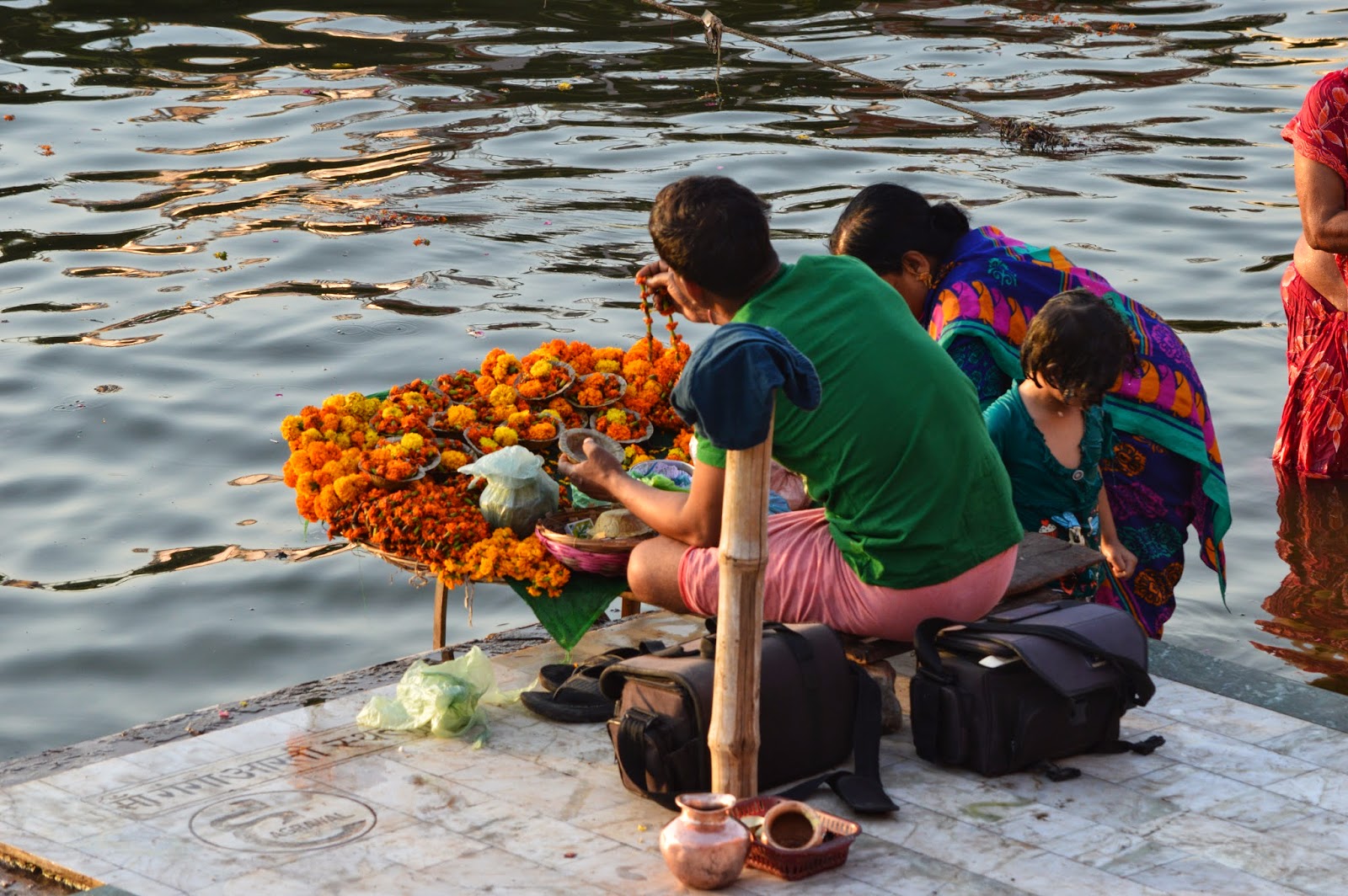
| A photogenic vendor of ritual objects. |
 |
| A headshaven worshiper. |
 |
| A snack vendor set up business at the ghat. |
 |
| The altar of a priest. |
 |
| Ritual objects awaits customers. |
 |
| A tea vendor walking the ghats. His kettle a genius one-it is attached to a metal tube filled with glowing charcoal. |
 |
| Laundry at the river. These are professional launderers. |
 |
| There are also a few people fishing in the ghat area. |
 |
| Cleaning up the smaller of two cremation sites. The people taking care of the cremation process are dooms-a group of outcasts, and the job is inherited. The dooms are considered unclean by the more fortune members of society. |
 |
| Mountains on firewood line the burning ghats. |
 |
| The final stop for a hindu. |